MARKET REACTION POST THE US-ISRAEL ATTACK ON IRAN
We are one week into the war in Iran and equity market reaction sparked surprising rotation, both geographically and sector-wise.
Theoretically, the more crude oil price rises, the bigger the headwind for equities. This week, Brent and WTI oil prices rallied by +25.4% to $86.95 and +20.2% to $83.90 per barrel respectively at the time of writing.
Oil prices are now at the highest level since July 2024 and are trading 3.7 standard deviation above the 50-day moving average (the most overbought since last June when the US bombed Iran nuclear sites). Golden cross formation (50-day moving average rise above the 200-day moving average) signals a bullish technical development. There was 9 such instances in the WTI market since the early 1980s.
Some argue that oil price has not fully reacted to the magnitude of the shock*, because there is the question of duration and whether there will be permanent damage to physical infrastructure in the region that will make it hard to resume production.
According to Goldman Sachs’ estimate, the current rise in oil price will lead to a modest drag on global GDP growth (-0.1%) and boost headline inflation (+0.2%). Unless inflation is high, central banks have historically not responded to oil price shocks on average as they tend to be short-lived. Ultimately, factors such as political objectives, military capabilities amongst others will define the length of the conflict and its global impact.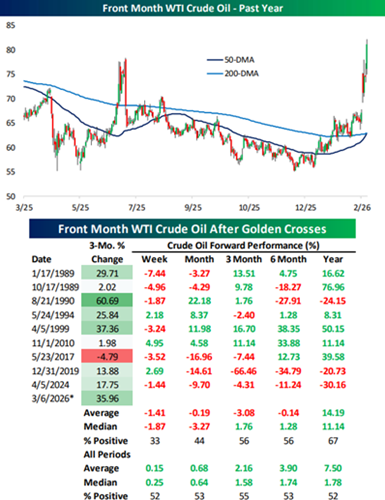
Yet, US stock markets crept into positive territory (MSCI USA: +0.4% in MUR as at 5-Mar-26) for the week despite the turbulence in the Middle East. Israel was the top performer as market is heavy in sectors that tend to benefit from rising geopolitical tensions such as Defence, Energy and Financials. For the rest of the world, the tone was more pessimistic. At sector level, one would have expected to see a rush into defensive themes as investors rein in risk at the expense of cyclical themes. So far, the opposite played out. Excluding Energy as an obvious outperformer, the other 3 sectors in the S&P500 that led the rally were: Technology, Consumer Discretionary and Financials. Defensive sectors such as Consumer Staples, Health Care and Utilities were amongst the main detractors: 
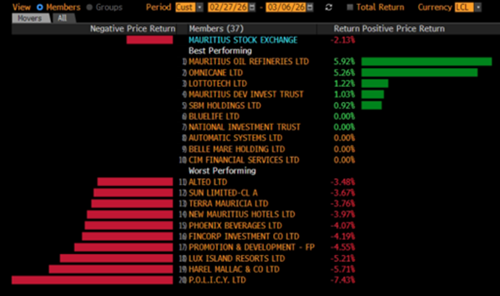
The Mauritian bourse, as represented by the SEMDEX, dropped by 2.1% in MUR. Foreign activity on the Official Market witnessed a net outflow of MUR 85.7 million in the first week of Mar-26 (versus a net outflow of MUR 7.1 million in the previous week). MCBG (-2.2%) took the lion’s share with a net outflow of MUR 80.2 million (representing nearly 94% of the net foreign sales during the week). However, the hotel segment took the brunt of the drop as investors immediately price in lower travel demand, higher fuel costs, and disruptions to global flights, which directly affect hotel earnings.